
Trump may strike. He may announce productive talks and extend again. He may do both at the same time. Iran will not open the Strait on someone else's terms, so no matter what happens, that problem will remain unsolved. And the IRGC will still be collecting its $2 million toll from every ship bold enough to ask permission to pass.

Goldman Sachs is bullish about Indian aerospace and defence, preferring private companies over public sector units (PSUs) as the country ramps up its export target for the sector to Rs 50,000 crore by FY29 from Rs 23,600 crore last year. The American investment bank's top 'buy' recommendations include Solar Industries, Bharat Electronics, Data Patterns and PTC Industries, while Bharat Dynamics is rated 'sell'.

Customs regimes can lead to labyrinthine legal disputes. Budget 2026 must recognise that an excessively defensive Customs posture can itself become a trade barrier, point out Mukesh Butani and Shankey Agrawal.

Egypt, Pakistan, Saudi Arabia and Turkey met in Islamabad in what analysts say is the formal opening of a new diplomatic formation that could reshape the post-war regional order. Their immediate goal is a ceasefire; their larger ambition is to ensure that neither Iran nor Israel emerges from this war in a dominant position. Pakistan's foreign minister then flew directly to Beijing and mooted a Chinese role as guarantor of any eventual agreement. Prem Panicker continues his must read daily blog on the Gulf War.
With inflation comfortably below the Reserve Bank of India's (RBI's) 4 per cent median target and likely to undershoot its 3.7 per cent projection for 2025-26 (FY26), there is room for the monetary policy easing cycle to be sustained, the Finance Ministry said on Monday. The comments, featured in the ministry's Monthly Economic Review for June 2025, assume significance ahead of the Monetary Policy Committee (MPC) meeting of the Reserve Bank of India (RBI) scheduled to begin from August 5.

The government's target of hitting $52 billion to $58 billion in mobile phone exports in FY26 has been faltering; an Indian corporate group with financial muscle will help.

The question is no longer whether the war will expand. It has. The next few days will tell us whether the war stabilises around Hormuz or whether the Strait itself becomes the trigger for a far larger rupture. What to watch for over the next 48 hours is simple: Any move by the US toward direct naval control of the Strait; any credible Iranian attempt to disrupt or mine shipping lanes and, critically, whether energy infrastructure in the Gulf continues to be targeted.If those lines are crossed in tandem, the war will no longer be containable within the region.

'The problem is not just slower growth, but also the quality of growth.'

The idea, Shah explains, was to keep the discipline of a shared start, without asking anyone to participate in a religious act that wasn't theirs. The anthem, he felt, offered a "common minimum" that didn't privilege one faith over another: stand together, start together, get to work.

Investors and startup executives are calling for extending the period for an entity to be recognised as a startup from 10 to 15 years for deep-tech companies.

In the Indo-Pacific's new era -- where perception shapes reality faster than treaties -- the real entrapment is not of China or the United States. It is the test Japan has set for itself -- and whether partners like India, acting as balancers rather than accelerants, can help ensure that the story ends in stability, points out Varun Arya.

Security agencies have uncovered a vast network of 'mule accounts' in Jammu and Kashmir used to launder money for global scams, raising concerns about potential links to separatist activities.

This weekend, Donald Trump has begun to say the quiet part out loud -- that he wants to take control of Iran's oil, a formulation more in line with his robber-baron style of international relations.

Indian exports to the US will face a 10% tariff, down from 25%, for 150 days following a US Supreme Court ruling. However, uncertainty persists due to potential further tariff hikes and long-term implications.
India's exports are becoming less vulnerable to changes in world demand and exchange rates, according to a publication titled 'Re-examining Narratives: A Collection of Essays', penned by chief economic advisor (CEA) V Anantha Nageswaran and his team. The publication pointed out that this conclusion has been drawn from the fact that there has been a decrease in the income elasticity of exports to 3.44 during 2009-2022, from 5.67 during 1991-2008, and in the inverse price elasticity of exports to 0.4 from 2.7. While a decline in elasticities is favourable in the presence of downside risks such as a decline in global demand and an appreciation of exchange rates, it may not be beneficial during boom periods.

Iran is fighting a different war: Older, slower, and in some ways more dangerous. Iran doesn't need to shoot down an F/A-18. It only needs to make the Strait of Hormuz feel dangerous long enough for insurance markets, shipping companies, and oil futures traders to do the rest. Prem Panicker continues his must-read daily blog on the war in the Middle East.

Across all sectors, the future of work depends on adaptability.

If you are actively trading, you can't possibly overlook headlines. Early announcements, policy changes, or even a disruption in a certain industry habitually grab your attention. These headlines, when strategically assessed, can generate profitable trading ideas.

Foreign investors fled Indian equities in 2025 at a scale never seen before, pulling out a record Rs 1.6 lakh crore (USD 18 billion) as volatile currency movements, global trade tensions, especially potential US tariffs, and stretched valuations eroded risk appetite, though flows are expected to turn sustainably positive in 2026.

US President Donald Trump's announcement of 25 per cent tariff on all goods coming from India starting August 1, plus an unspecified penalty, is expected to impact Apple's plans to expand iPhone manufacturing in India as well as export of other electronics to the US. The move comes at a time when Indian electronics production is reeling under pressure due to restrictions imposed by China on supply of several critical components, capital goods and even skilled technology professionals.

Alliances fight wars effectively only when they share an endgame. If Israel acted without US knowledge, then the military alliance is operating without real coordination at the level of strategic targeting. Neither picture is reassuring in a war that is no longer regional in its consequences. Prem Panicker continues his must read daily blog on the Gulf War.

'As long as Sebi maintains transparency and market stability, the Jane Street episode is unlikely to deter long-term foreign capital.'

The delegations from the US and Iran head to Islamabad on Friday, carrying a ceasefire that is already fraying, a Strait that is technically open and practically closed, and a negotiating agenda that would challenge even parties actually negotiating in good faith, which these groups are not. Prem Panicker continues his must read blog on the Iran War.

Amidst strained ties with China, the pre-budget Economic Survey on Monday made a strong case for seeking foreign direct investments (FDI) from Beijing to boost local manufacturing and tap the export market. As the US and Europe are shifting their immediate sourcing away from China, it is more effective to have Chinese companies invest in India and then export the products to these markets rather than importing from the neighbouring country, the Survey said.

For decades, multinational pharmaceutical companies and Indian drugmakers worked in ways that supported each other: MNCs brought innovation and brands, while Indian companies built scale through generics and cost efficiency. There was an important overlap - generic drugs - but this is shrinking fast. And the consequences are reshaping India's gigantic pharmaceutical market.

'Solutions developed in India are being commercialised and offered globally because we're executing at scale, creating new markets and revenue streams.'

For weeks, the war skirted the edge of catastrophe without tipping over. Missiles flew, there was much destruction, commanders were assassinated, cities across the Gulf and even in Israel struggled to absorb the shock. But one line held: Energy infrastructure, the arteries of the global economy, remained largely untouched. That is no longer true. Prem Panicker continues his must read daily blog on the Gulf War.

By all available indications, the White House drafted a face-saving note and handed it, ready-made, to Islamabad. Pakistani Prime Minister Shehbaz Sharif was supposed to then post it in the guise of a plea urging Trump to extend the deadline by two weeks 'to allow diplomacy to run its course'. Trump would then graciously accept Pakistan's 'request' and declare a ceasefire. Sharif dutifully posted the message on X. Except that he, or whoever was handling the account, forgot to delete the tell-tale first line visible in the edit history: 'Draft - Pakistan's PM Message on X'. Prem Panicker's must read blog on the Iran War.

Hyundai aims to raise exports to 30% of output by FY30 as domestic sales slow; six EVs among 26 product launches planned as part of long-term growth strategy.

With the rapid evolution of channels like quick-commerce and the emergence of ONDC, the Indian retail industry is 'cautiously optimistic' for 2025, in which new-age technologies such as AI and automation will play a crucial role, driving efficiency and personalisation.
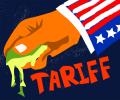
'If the near-term economic pain is absorbed more by those who have the ability and the financial strength to do so, then small and medium enterprises in downstream industries will emerge stronger from the trade imbroglio.'
It started out as a Production Linked Incentive (PLI) scheme to make India an export hub. But after many a twist and turns, the latest 2.0 PLI for IT hardware, for which the 40 eligible candidates have applied till its deadline, is now focused on 'import substitution'. The scheme will help in reducing India's over-dependence on imports (80 per cent of laptops are imported), especially from China which include laptops, tablets and servers.

Audi plans to focus the Indian market, including deepening market penetration and increasing sales volume.

Russian President Vladimir Putin's visit to India this week aims to secure energy supplies, stabilise defence deliveries and ensure bilateral trade continues smoothly despite strong Western sanctions, GTRI said on Tuesday.

Donald Trump's inconsistent statements and actions regarding the conflict with Iran have drawn criticism and confusion, raising questions about American credibility and the direction of US foreign policy.

For India to transform into a high-income country with a projected gross domestic product (GDP) of $23-35 trillion, will need a sustained annual growth of 8 per cent to 10 per cent. This will be powered by India's demographic dividend, technological innovation, and sectoral transformation, according to the "India@2047: Transforming India Into A Tech-Driven Economy" report by Bain & Company and Nasscom. By 2047, the services sector is expected to contribute 60 per cent of India's GDP, while manufacturing will account for 32 per cent, both playing a pivotal role in economic expansion.

N Chandrasekaran, chairman of Tata Consumer Products, has said in the company's annual report for FY25 that India remains one of the bright spots of economic growth amid a volatile global environment. He said India's long-term growth was underpinned by strong demographic and economic fundamentals as well as structural reforms.
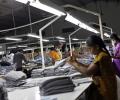
In the shadows of a sliding rupee, India's knitwear hub Tiruppur is weaving a success story. While the domestic currency edges closer to the 86 mark against the US dollar, triggering concerns for many sectors, this textile town in Tamil Nadu is finding opportunity in adversity: Between April and December alone, Tiruppur's exports reached Rs 26,000 crore, almost eclipsing last financial year's total of Rs 30,690 crore.

The automobile industry has sought government support in expediting approvals from the Chinese government for importing rare earth magnets used in various applications, including passenger cars. As per the industry sources, various domestic suppliers have already sought approval from the Chinese government through their local vendors in China.

The Union Budget for 2026-27, presented by Finance Minister (FM) Nirmala Sitharaman on Sunday, which was a first, had an excellent domestic macro backdrop. According to the first advance estimates, gross domestic product (GDP) in constant prices is projected to grow 7.4 per cent in the current financial year, against 6.5 per cent in 2024-25.
